Yogini Hridayam _ 🧘 Purnabhisheka (Complete Initiation)
Chakra Sanketa Vibhaga – The Significance of Purnabhisheka (Complete Initiation)
Óm
Welcome to the Yogini Hridayam series, article read by SriVidya Pitham.
In this article, we shall explore the meaning and significance of ” Purnabhisheka ” (पूर्णाभिषेक) within the SriVidya tradition.
The Yogini Hridayam discusses the significance of the Guru who confers Purnabhisheka and the importance of worshipping the sacred Padukas 🙌 of that Guru. To understand this concept properly, we must first understand the traditional sequence of initiations in SriVidya.
1. What Is Purnabhisheka in the SriVidya Tradition?
Before understanding Purnabhisheka, it is essential to become familiar with the traditional sequence of initiations, known as SriVidya Kramadiksha.
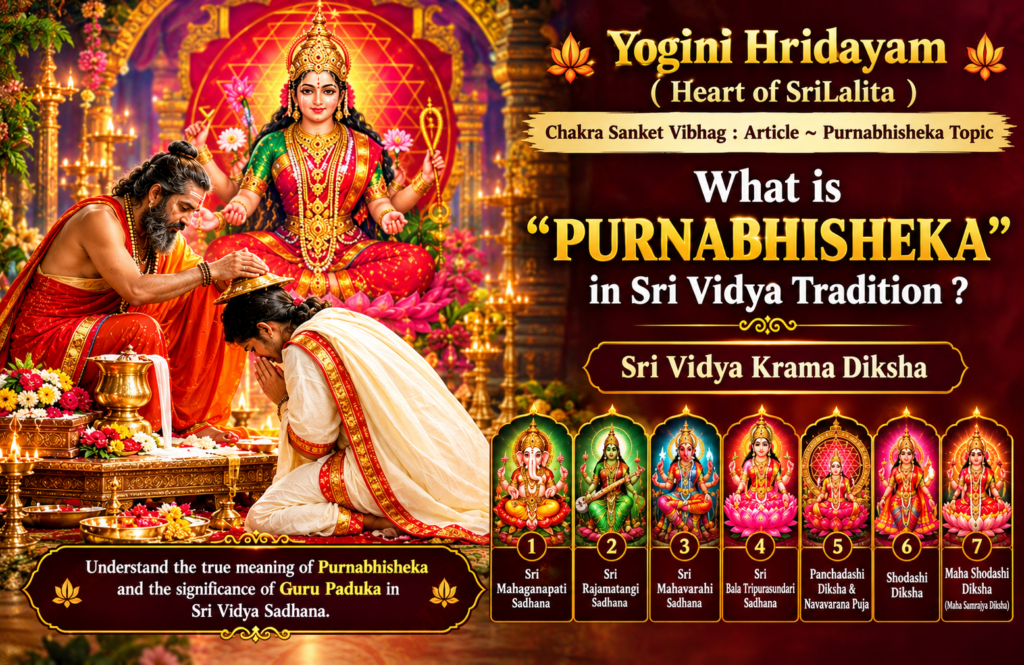
The fundamental sequence of SriVidya Kramadiksha comprises the following 8 stages:
- Sri MahaGanapati Sadhana
- Sri RajaMatangi Sadhana
- Sri MahaVarahi Sadhana
- Sri Bala TripuraSundari Sadhana
- Panchadashi Diksha and Navavarana Puja
- Shodashi Diksha
- Mahashodashi Diksha
- Rajarajeshwari Diksha
These stages form a comprehensive system of spiritual practice that, according to the tradition presented here, must be undertaken in a systematic and properly guided manner.
Two practices are not ordinarily taught simultaneously. Each Vidya requires sustained practice, with at least a year devoted to its proper study and observance.
This distinction is particularly important:
Kaulachara refers to the prescribed ritualistic and practical discipline.
Samayachara refers to the inner or internalised mode of worship.
Within the approach described here, Samayachara follows the proper establishment of Kaulachara. Understanding this relationship is essential to appreciating the traditional framework of SriVidya sadhana.
Mahashodashi Diksha and Mahasamrajya Diksha
Mahashodashi Diksha is also known as Mahasamrajya Diksha.
However, it is important to understand that the traditional SriVidya path is not simply a matter of receiving a mantra. It involves a gradual process of spiritual education, disciplined practice, ritual understanding and the transmission of knowledge under the guidance of a qualified Guru.
Mantras associated with these seven stages may be found on Google, YouTube and in various books. Nevertheless, merely reading a mantra, repeating it or obtaining it from another person does not, in itself, constitute formal initiation. A mantra and a genuine initiation are not the same thing.
The traditional approach requires a practitioner to devote sustained effort to each subject, develop a deep understanding of the associated practices and pursue mastery of the knowledge involved. Spiritual progress is not measured merely by the number of mantras received or the speed with which someone advances through different initiations.
Purnabhisheka in Shodashi Diksha
Within the SriVidya sequence described in this article, Purnabhisheka takes place at the stage of Shodashi Diksha. Reaching this stage, however, is considered exceptionally difficult.
Today, some practitioners receive mantras associated with advanced SriVidya practices without necessarily completing the preparatory disciplines or acquiring the corresponding knowledge. According to the traditional perspective presented by SriVidya Pitham, receiving such mantras alone should not be confused with completing the initiation process.
Purnabhisheka represents a significant stage of spiritual preparation and the transmission of knowledge from Guru to disciple.
The Preparation Required for Purnabhisheka
According to the approach described here, a practitioner preparing for Purnabhisheka must spend at least one year in the close company of the Guru.
During this period, the practitioner must receive advanced instruction and develop the understanding required for this stage.
Shodashi Diksha is not merely the receipt of a mantra. It also involves understanding the principles of Kalachakra Vidya (the knowledge of the wheel of time).
The practitioner must develop the necessary understanding before proceeding to the ritual of Purnabhisheka.
The Traditional Ritual of Purnabhisheka
Once the Guru determines that the disciple has acquired the necessary knowledge, the ritual is performed at an auspicious time.
According to the tradition described here, the Guru prepares and decorates a ritual platform or seat (Chowki) in accordance with the prescribed procedure.
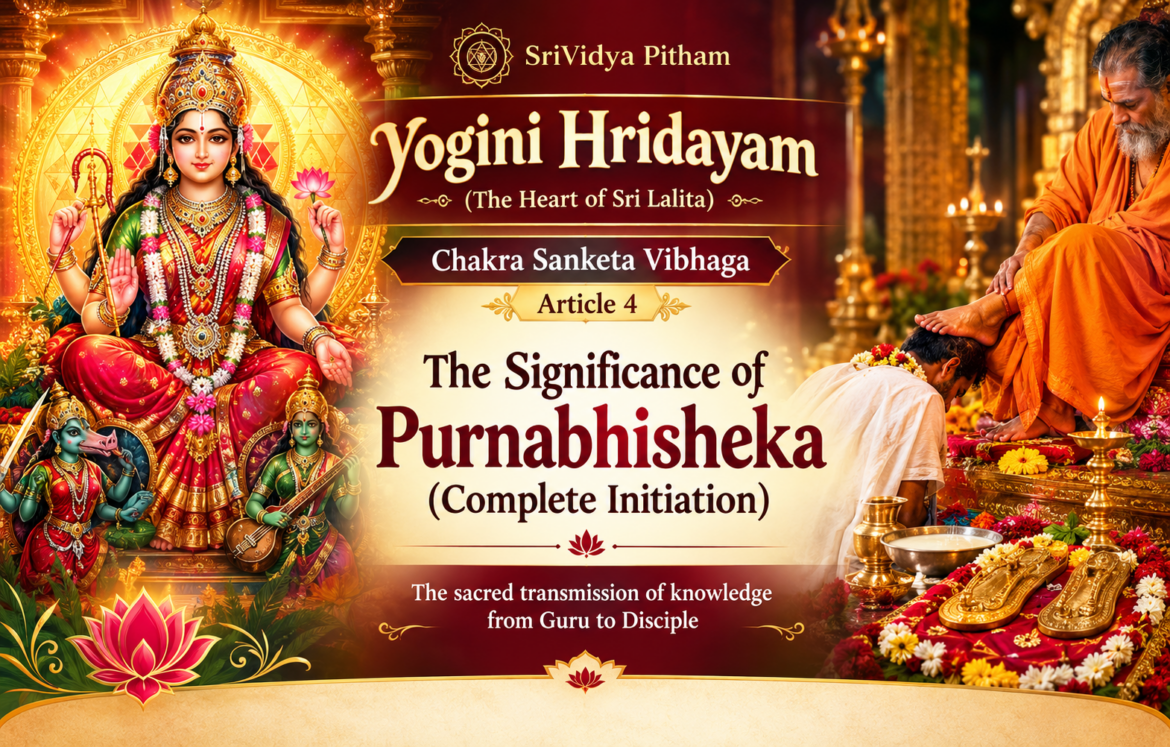
The disciple is seated upon this platform and bathed with Panchamrita, a sacred mixture traditionally consisting of five ingredients. Following this ritual, the Guru places his feet upon the disciple’s head. This act holds deep significance within the Guru–disciple tradition.
It represents the disciple’s reverence for the Guru and the transmission of spiritual knowledge. It is in this context that the Guru’s Padukas acquire their significance as an object of worship.
What Does Purnabhisheka Signify?
The essential meaning of Purnabhisheka, as explained in this tradition, is the transmission of the knowledge embodied by the Guru to the disciple.
It is not merely an external ritual or a ceremonial event. It signifies the culmination of a period of preparation, learning and spiritual discipline. The tradition also associates this initiation with an independent spiritual naming of the disciple.
According to SriVidya Pitham’s understanding of the traditional process, such practices are rarely encountered in their complete form today because they require a high level of knowledge and competence from the Guru.
Wearing saffron robes alone does not make a person a qualified Guru. The role requires genuine knowledge, the ability to guide a disciple and a proper understanding of the spiritual tradition being taught.
How Has the Sequence of SriVidya Initiation Evolved?
According to the traditional account presented here, SriVidya practice was followed differently in earlier times. In the past, the sequence of SriVidya initiation began with Sri Bala Tripurasundari Sadhana.
As social and family-related difficulties increased over time, Sri Mahaganapati Sadhana came to occupy the first position in the sequence described by this tradition.
Different institutions and lineages may follow different preparatory practices today.
For example, certain places require practitioners to complete one hundred thousand repetitions each of the Pratyangira and Mahapratyangira mantras before inviting them to receive SriVidya initiation. Other places begin with the mantras of Sri Bala and Sri Mahaganapati, followed by instruction in Sri Mahaganapati Sadhana.
There are also instances in which practitioners are given mantras ranging from Mahaganapati to Shodashi within just three days.
However, according to the traditional position presented by SriVidya Pitham, receiving several mantras within a few days should not be mistaken for completing the corresponding initiations and acquiring the knowledge associated with them.
A systematic spiritual path requires more than the rapid transmission of mantras. It calls for proper instruction, disciplined practice, a thorough understanding of the prescribed rituals and appropriate guidance from a qualified Guru.
Why Is Even the First Initiation Considered Difficult?
Within the SriVidya system described here, reaching the stage of Sri Mahaganapati Sadhana itself is considered a demanding undertaking.
The subsequent stages require progressively deeper study and practice.
Therefore, the entire sequence should not be understood as a collection of mantras that can simply be acquired one after another. It is a structured spiritual discipline in which each stage builds upon the practitioner’s preparation and understanding of the preceding stage.
The purpose of this approach is to emphasise the importance of authentic instruction, sustained practice and a proper understanding of the SriVidya tradition.
A genuine spiritual journey requires patience. It cannot be measured merely by the number of initiations received or the speed with which one progresses through them.